
Understanding profit margin is essential for Australian business owners, freelancers, retailers and anyone selling products or services. It helps you determine how much of your revenue remains as profit after accounting for costs.
A profit margin calculator Australia helps you calculate your gross profit margin and understand how much profit your business makes from its sales. Instead of manually working through formulas, you can enter your revenue and costs to estimate your profit margin as a percentage.
Our Profit Margin Calculator Australia helps small business owners, freelancers and retailers calculate profit margins quickly using revenue and business costs. Enter your figures to understand how much profit your business earns as a percentage of sales.
Whether you operate an online store, a local shop, a service business or a small Australian company, knowing your profit margin can help you understand your pricing, expenses and business performance.
In this guide, you will learn how to calculate profit margin, understand the difference between profit margin and markup, and use practical examples in Australian dollars.
Quick Answer: How Do You Calculate Profit Margin?
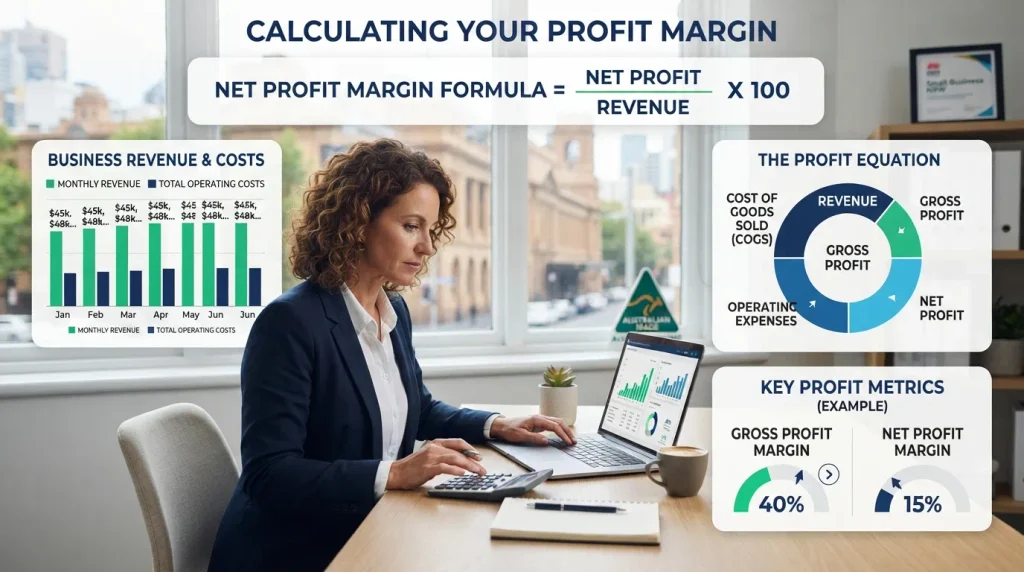
Profit margin is calculated by dividing profit by revenue and multiplying the result by 100.
Profit Margin Formula:
Profit Margin=RevenueProfit×100
For example, if an Australian business earns $10,000 in revenue and has $7,000 in costs, its profit is $3,000.
100003000×100=30%
The business has a profit margin of 30%, meaning it retains $30 in profit for every $100 of revenue, based on the costs included in this calculation.
Use our Profit Margin Calculator Australia to calculate your profit margin quickly.
Understanding profit margin is essential for Australian business owners. Use our Profit Margin Calculator Australia to calculate your profit percentage quickly.
If you want to understand the difference between profit margin and markup, try our Markup Calculator Australia to calculate the markup percentage on your products and services.
Before making business pricing decisions, you can also use our Break-Even Calculator Australia to estimate how many products or services you need to sell to cover your costs.
For GST-related calculations, visit our GST Calculator Australia to calculate GST-inclusive and GST-exclusive amounts.
If you charge clients for services, our Invoice Calculator Australia can help you estimate invoice totals, discounts and GST.
Freelancers can also use our Freelance Rate Calculator Australia to estimate an appropriate hourly or project rate based on their costs and income goals.
Table of Contents
- What Is Profit Margin?
- How to Calculate Profit Margin
- Profit Margin Calculation Examples
- Gross Profit Margin vs Net Profit Margin
- Profit Margin vs Markup
- Why Profit Margin Matters
- Frequently Asked Questions
What Is Profit Margin?
Profit margin is a financial measurement that shows the percentage of revenue remaining as profit after subtracting relevant business costs.
It is usually expressed as a percentage rather than a dollar amount.
For example, two businesses might each generate $50,000 in monthly revenue. However, one business may have $10,000 in profit while the other has $5,000.
| Business | Revenue | Profit | Profit Margin |
|---|---|---|---|
| Business A | $50,000 | $10,000 | 20% |
| Business B | $50,000 | $5,000 | 10% |
Business A retains a larger proportion of its revenue as profit under these figures.
Profit margin can be calculated for an individual product, a service, a project or an entire business. The result depends on which costs are included.
For accurate financial reporting, it is important to distinguish between gross profit, operating profit and net profit.
How to Calculate Profit Margin
Calculating profit margin requires two main figures: revenue and profit.
Revenue is the money generated from sales, while profit is the amount remaining after deducting the relevant costs.
Step 1: Calculate Total Revenue
Revenue is the income generated from selling products or services before deducting business expenses.
For example, if a shop sells 200 products for $50 each:
200×50=$10,000
The total sales revenue is $10,000, before considering any applicable GST treatment, refunds or other adjustments.
Step 2: Calculate Total Costs
Add the costs that are relevant to the type of profit margin you want to calculate.
For gross profit, these generally include the direct costs of producing or purchasing the goods or services sold.
For net profit, you also need to account for operating expenses and other applicable expenses, such as rent, wages, interest and tax.
Step 3: Calculate Profit
Subtract the relevant costs from revenue.
Profit=Revenue−Costs
Example:
- Revenue: $10,000
- Total costs included: $7,000
- Profit: $3,000
Step 4: Calculate the Percentage
Divide profit by revenue and multiply by 100.
100003000×100=30%
The resulting profit margin is 30%.
Profit Margin Calculation Examples
The following examples demonstrate how profit margin works for Australian businesses using Australian dollars (AUD).
Example 1: Retail Shop
Suppose a retail shop sells products worth $20,000 in a month.
The cost of purchasing those products is $12,000.
| Calculation | Amount |
|---|---|
| Sales revenue | $20,000 |
| Cost of goods sold | $12,000 |
| Gross profit | $8,000 |
| Gross profit margin | 40% |
Calculation:
2000020000−12000×100=40%
The shop has a gross profit margin of 40%, before other operating expenses.
Example 2: Freelance Service Business
A freelance designer in Australia charges a client $2,000 for a project.
The direct costs included in the calculation are $500.
| Calculation | Amount |
|---|---|
| Project revenue | $2,000 |
| Direct project costs | $500 |
| Profit before other expenses | $1,500 |
| Margin | 75% |
20002000−500×100=75%
The project has a 75% margin based on the stated direct costs. If the designer wants to calculate net profit margin for the business, they must also consider relevant overheads and other expenses.
Example 3: Small Business With Operating Expenses
An Australian business records $100,000 in revenue.
Its total expenses, including the costs relevant to the calculation, are $85,000.
| Calculation | Amount |
|---|---|
| Revenue | $100,000 |
| Total expenses | $85,000 |
| Profit | $15,000 |
| Profit margin | 15% |
10000015000×100=15%
This means the business retains $15 in profit for every $100 of revenue, based on the expenses included.
For official information about GST registration, taxable sales and GST credits, visit the Australian Taxation Office (ATO) GST guidance .
For information about business structures, record keeping and managing a business in Australia, visit the Australian Government business website .
For general information about Australian business financial reporting and accounting standards, visit the Australian Accounting Standards Board (AASB) .
Gross Profit Margin vs Net Profit Margin
Gross profit margin and net profit margin measure different aspects of business profitability.
Gross profit margin focuses on the relationship between sales revenue and the direct cost of goods or services sold. Net profit margin considers a broader range of expenses.
| Feature | Gross Profit Margin | Net Profit Margin |
|---|---|---|
| Main purpose | Measures profitability after direct costs | Measures overall profitability after expenses |
| Costs included | Cost of goods sold or direct service costs | Direct costs, operating expenses and other applicable expenses |
| Formula | Gross profit ÷ revenue × 100 | Net profit ÷ revenue × 100 |
| Common use | Product and service profitability | Overall business performance |
Gross Profit Margin Formula
Gross Margin=RevenueRevenue−COGS×100
COGS means cost of goods sold.
For a retailer, this may include the purchase cost of products sold. For a service business, direct costs may include costs directly associated with delivering the service.
Net Profit Margin Formula
Net Margin=RevenueNet Profit×100
Net profit is calculated after accounting for the relevant business expenses and other items under the applicable accounting method.
The precise calculation can vary depending on the financial statements and whether tax, interest or other items are included.
Profit Margin vs Markup
Profit margin and markup are related but are not the same.
Profit margin measures profit as a percentage of the selling price or revenue. Markup measures profit as a percentage of the cost.
For example, if a product costs $60 and sells for $100, the profit is $40.
| Measurement | Calculation | Result |
|---|---|---|
| Profit margin | $40 ÷ $100 × 100 | 40% |
| Markup | $40 ÷ $60 × 100 | 66.67% |
A 40% profit margin does not mean a 40% markup.
This distinction matters when setting prices for products and services. Using markup as if it were profit margin can lead to incorrect pricing decisions.
You can also use our Markup Calculator Australia to calculate markup percentages.
For further calculations, explore our Break-Even Calculator Australia to estimate the sales required to cover business costs.
Why Profit Margin Matters for Australian Businesses
Profit margin can help business owners understand how effectively their revenue covers costs and generates profit.
1. Understand Product Profitability
Calculating margins for individual products can help identify which products contribute more gross profit relative to their sales.
2. Review Pricing
If costs increase, a business can use margin calculations to understand how a change in selling price affects profitability.
However, pricing decisions also depend on customer demand, competition and other business considerations.
3. Monitor Business Expenses
Comparing profit margins over different periods can help identify changes in expenses or revenue.
For example, if sales remain stable but net profit margin decreases, the business may need to review its operating costs or other financial factors.
4. Support Financial Planning
Profit margin is one of several financial measurements that can be used when preparing budgets and business forecasts.
It should be considered alongside cash flow, revenue, debt obligations and other financial indicators.
How Does GST Affect Profit Margin in Australia?
Goods and Services Tax (GST) is an important consideration for Australian businesses that are registered for GST.
The standard GST rate in Australia is 10% for taxable supplies, although GST treatment depends on the type of supply and applicable rules.
For a GST-registered business, GST collected on taxable sales is generally not treated as business revenue. Similarly, eligible GST credits may be available for business purchases.
For consistent margin calculations, revenue and costs should generally be compared on a GST-exclusive basis where the business can claim the relevant input tax credits.
For example, if a taxable sale is $110 including GST, the GST-exclusive amount is $100 and the GST component is $10.
This is a simplified example. Actual GST treatment depends on the transaction and eligibility for credits.
For official information, visit the Australian Taxation Office (ATO) GST guidance .
You can also use our GST Calculator Australia to calculate GST-inclusive and GST-exclusive amounts.
Try our Profit Margin Calculator Australia to calculate your profit margin and make more informed pricing decisions for your business.
Frequently Asked Questions
1. What is the formula for profit margin?
The formula is profit divided by revenue, multiplied by 100. For example, $2,000 profit on $10,000 revenue gives a profit margin of 20%.
2. How do I calculate a 20% profit margin?
Divide your profit by revenue and multiply by 100. If your profit is $2,000 and revenue is $10,000, your profit margin is 20%.
3. Is profit margin the same as markup?
No. Profit margin is calculated using revenue as the denominator, while markup is calculated using cost. A 40% margin and a 40% markup produce different selling prices.
4. Should GST be included when calculating profit margin in Australia?
For a GST-registered business entitled to claim applicable GST credits, revenue and costs are generally compared excluding GST for consistent profit calculations. Specific GST treatment depends on the transaction and the business’s circumstances.
5. Can profit margin be negative?
Yes. If the relevant costs exceed revenue, the business records a loss and its profit margin is negative.
For example, revenue of $10,000 and costs of $12,000 produce a loss of $2,000 and a margin of -20%.
6. What is a good profit margin for a small business in Australia?
There is no single profit margin that is suitable for every Australian business. Margins vary by industry, business model, operating costs and the type of margin being measured.
Comparing a business with relevant industry benchmarks and its own historical results can provide useful context.
7. How can I calculate profit margin quickly?
Enter your revenue and relevant costs into the Profit Margin Calculator Australia. The calculator can help estimate profit and the corresponding margin percentage.
Final Thoughts
Profit margin is a useful financial measurement for understanding how much profit a business earns relative to its revenue.
By distinguishing between gross profit margin, net profit margin and markup, Australian business owners can make more consistent calculations and better understand their financial results.
Use the free Profit Margin Calculator Australia to calculate your margin, and explore our other business calculators for related financial estimates.
Disclaimer: This article provides general educational information and is not financial, tax, accounting or legal advice. Calculations are estimates and should be checked against your actual business records and applicable Australian requirements.